Why Dubai Heat Destroys Mercedes Engine Oil Faster
Posted by Royal Swiss Auto Xpress
Filed in Family & Home 81 views
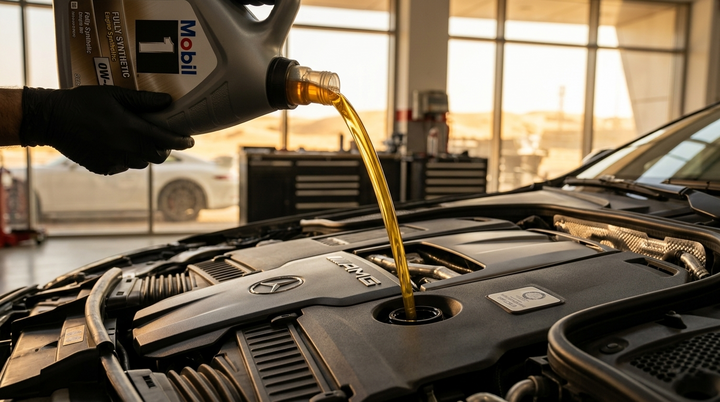
If you own a Mercedes-Benz in Dubai, you already know the city demands a lot from your vehicle. The relentless summer heat, heavy urban traffic, and long stretches of highway driving create a punishing environment for any engine — but especially for one engineered with the tight tolerances and advanced components that Mercedes-Benz is known for.
Most Mercedes owners focus on when to change their engine oil. Fewer stop to ask why the interval matters so much more in the UAE than in cooler climates. The answer lies in some straightforward chemistry, and understanding it can genuinely extend your engine's life.
What Engine Oil Actually Does Under the Hood
More Than Just Lubrication
Engine oil is often described as the lifeblood of any vehicle, but that description understates its complexity. A modern synthetic oil inside a Mercedes-Benz engine performs at least four critical jobs simultaneously: it lubricates metal surfaces moving at thousands of revolutions per minute, it acts as a coolant for parts the water-based cooling system cannot reach, it suspends and transports microscopic metal shavings and combustion byproducts toward the oil filter, and it forms a protective chemical barrier against corrosion.
When any one of these functions begins to fail, the others follow quickly. And in Dubai's climate, the conditions that cause failure arrive much earlier than the manufacturer's baseline intervals assume.
How Extreme Heat Accelerates Oil Degradation
Viscosity Breakdown: The Silent Threat
Viscosity — the oil's resistance to flow — is its most critical property. Engine oil is rated by grades such as 5W-40 or 0W-40, where the second number describes viscosity at operating temperature. In standard conditions, a quality synthetic oil maintains that rating reliably. In Dubai summers, where ambient temperatures regularly exceed 45°C before the engine even fires, the starting point is dramatically higher.
When an engine in this environment reaches operating temperature, the oil is already working far harder than its baseline design anticipates. Prolonged exposure to these temperatures causes the long polymer chains inside synthetic oil to literally break apart — a process called viscosity breakdown. Once this occurs, the oil becomes thinner than its rating promises, film strength decreases, and metal-to-metal contact increases in the places it should never occur.
Oxidation and Sludge Buildup
Heat also accelerates oxidation — the chemical reaction between oil molecules and oxygen that causes the oil to thicken, darken, and form varnish and sludge deposits inside the engine. In temperate climates, oxidation is a gradual process. In the UAE, the elevated base temperature dramatically shortens the time it takes for oil to oxidise to the point where it becomes counterproductive.
Sludge is particularly damaging in high-revving Mercedes engines because it tends to accumulate in the narrow oil passages and galleries that feed the camshafts, variable valve timing actuators, and turbocharger bearings. These are precisely the components that are most sensitive to oil starvation — and most expensive to repair if they're damaged.
Stop-and-Go Traffic Makes Everything Worse
Short Trips, Incomplete Heat Cycles
Dubai's urban driving pattern — frequent traffic congestion on Sheikh Zayed Road, short journeys between air-conditioned destinations, and extended idling in parking structures — creates a secondary problem alongside the heat. These conditions mean the engine frequently reaches partial operating temperature without completing a full heat cycle.
A complete heat cycle allows moisture and light fuel contaminants that enter the oil during cold starts to evaporate off. When the engine is shut down before this happens, those contaminants remain suspended in the oil and progressively compromise its protective additives. Combined with thermal oxidation from the ambient heat, this creates a compounding degradation effect that effectively halves the useful life of even the best quality synthetic oil compared to what the same oil would last in a European climate.
The Turbocharger Problem
Many current Mercedes-Benz models — across the C-Class, E-Class, GLC, and GLE ranges — are turbocharged. Turbocharger bearings operate at extraordinarily high temperatures and are fed exclusively by engine oil. When oil quality deteriorates, the turbocharger is among the first components to experience accelerated wear, and also one of the most costly to replace.
Maintaining full oil viscosity and additive integrity is not optional on a turbocharged Mercedes operating in Dubai conditions — it is the single most important factor in preserving turbocharger longevity.
What This Means for Your Maintenance Schedule
Rethinking Manufacturer Intervals for UAE Conditions
Mercedes-Benz factory service intervals are typically set for average global driving conditions — a reasonable mix of highway and urban driving in a moderate climate. Dubai is neither moderate nor average. The combination of extreme ambient heat, urban stop-and-go patterns, and high-quality synthetic oil that still degrades faster than baseline projections means that standard intervals should be treated as maximums rather than targets.
For comprehensive guidance on the specific synthetic oils that meet Mercedes-Benz specifications — including the MB 229.5 and MB 229.51 approval ratings that are mandatory for turbocharged and AMG variants — and the recommended service intervals for UAE driving conditions, the Mercedes oil change Dubai complete guide covers these topics in thorough detail, including signs that your oil needs immediate attention regardless of mileage.
Choosing the Right Workshop Matters Too
Using the correct oil grade is only half the equation. The oil filter, the fill quantity, and the service indicator reset must all be handled correctly. Underfilling by even 200ml on a Mercedes V6 or V8 can meaningfully increase the oil temperature and accelerate all of the degradation processes described above. A workshop that specialises specifically in Mercedes-Benz vehicles — and uses the approved oil grades and OEM-specification filters — eliminates these variables.
Key Takeaways for Dubai Mercedes Owners
Understanding the chemistry behind engine oil degradation is not just academic. It translates directly into practical decisions: how often you schedule your next oil change, which workshop you trust with your vehicle, and whether you monitor your dashboard service indicator as a hard deadline or a rough suggestion.
Dubai's climate is genuinely one of the most demanding environments a luxury car engine will ever face. A 5W-40 fully synthetic oil that would last 15,000 km in Hamburg may be working at its limits well before 10,000 km in a Dubai summer. That gap is the difference between an engine that reaches 300,000 km in excellent condition and one that begins showing wear-related symptoms at half that mileage.
Treating your engine oil change schedule as one of the most consequential decisions in your vehicle's maintenance calendar is not excessive caution — in Dubai, it is simply accurate.