Debouncing and Throttling in Frontend Development
Posted by melllow thomas
Filed in Arts & Culture 178 views
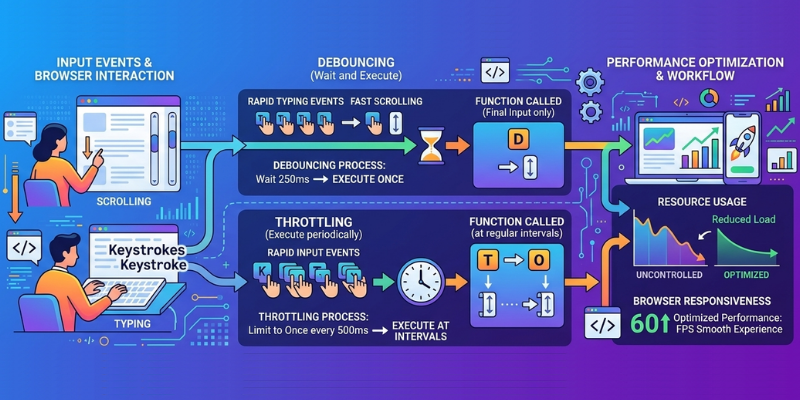
Modern web applications respond to many user interactions such as scrolling, resizing, typing, and clicking. These actions can trigger functions repeatedly within a very short time. When too many events fire at once, the browser may struggle to process them efficiently. This can reduce performance and create a slow user experience.
Debouncing and throttling are techniques that help control how frequently certain functions run. They help developers limit repeated execution so the browser handles tasks more efficiently. Learning these concepts is important for anyone building responsive interfaces, and developers who want deeper frontend expertise can consider enrolling in the Full Stack Developer Course in Mumbai at FITA Academy to strengthen their practical understanding of performance optimization.
Why Event Control Matters in Frontend Development
User interfaces often respond to high frequency events. Examples include scrolling through long pages, resizing the browser window, or typing inside a search bar. Each of these actions can trigger functions many times per second.
If these events run heavy logic every time they occur, the application can become inefficient. The browser might perform unnecessary calculations or repeated network requests. This may lead to lag, poor responsiveness, and wasted system resources.
Frontend developers use event control techniques to solve this issue. Debouncing and throttling help manage how frequently functions execute while still keeping the interface responsive and smooth.
Understanding Debouncing
Debouncing ensures that a function runs only after a certain period of inactivity. Instead of executing a function repeatedly during rapid events, the browser waits until the user stops performing the action for a specific time.
This approach is useful for situations where the final action matters more than the intermediate ones. For example, when a user types into a search field, the application may wait briefly before sending a request. This prevents the system from sending multiple unnecessary queries while the user is still typing.
Debouncing improves performance by reducing redundant function calls. It also improves user experience because the application responds more intelligently to user input. Developers who want to build optimized and scalable interfaces often practice these techniques in structured learning programs such as the Full Stack Developer Course in Kolkata where performance handling is part of real project training.
Understanding Throttling
Throttling works differently from debouncing. Instead of waiting for inactivity, throttling ensures that a function runs at a controlled interval. The function executes at most once within a specific time frame even if the event triggers repeatedly.
This technique is useful when continuous feedback is required but excessive execution must be avoided. Scrolling events are a good example. When a user scrolls through a page, the application might need to update elements or track progress. Throttling ensures that these updates occur at a manageable rate rather than on every tiny scroll movement.
By limiting the number of executions, throttling helps maintain stable performance. It allows applications to remain responsive while preventing unnecessary workload on the browser.
Debouncing vs Throttling
Although both techniques improve performance, their purpose differs slightly. Debouncing focuses on executing a function only after the user stops triggering events. Throttling focuses on executing a function at controlled intervals during continuous activity.
Developers choose between these methods based on the behavior they want to achieve. If the final action is most important, debouncing is often the better choice. If regular updates are required during continuous interaction, throttling becomes more useful.
Understanding the difference between these approaches helps developers design smoother and more efficient web interfaces.
Debouncing and throttling are essential concepts in frontend development. They help manage frequent browser events and improve application performance. By reducing unnecessary function calls, these techniques create smoother interactions and better user experiences.
Frontend developers who master performance optimization can build scalable and efficient web applications. If you want to gain deeper knowledge of frontend and backend concepts together, take the Full Stack Developer Course in Delhi to strengthen your full stack development skills and build high quality web applications.
Also check: Understanding HTTP Mocks and Stubs